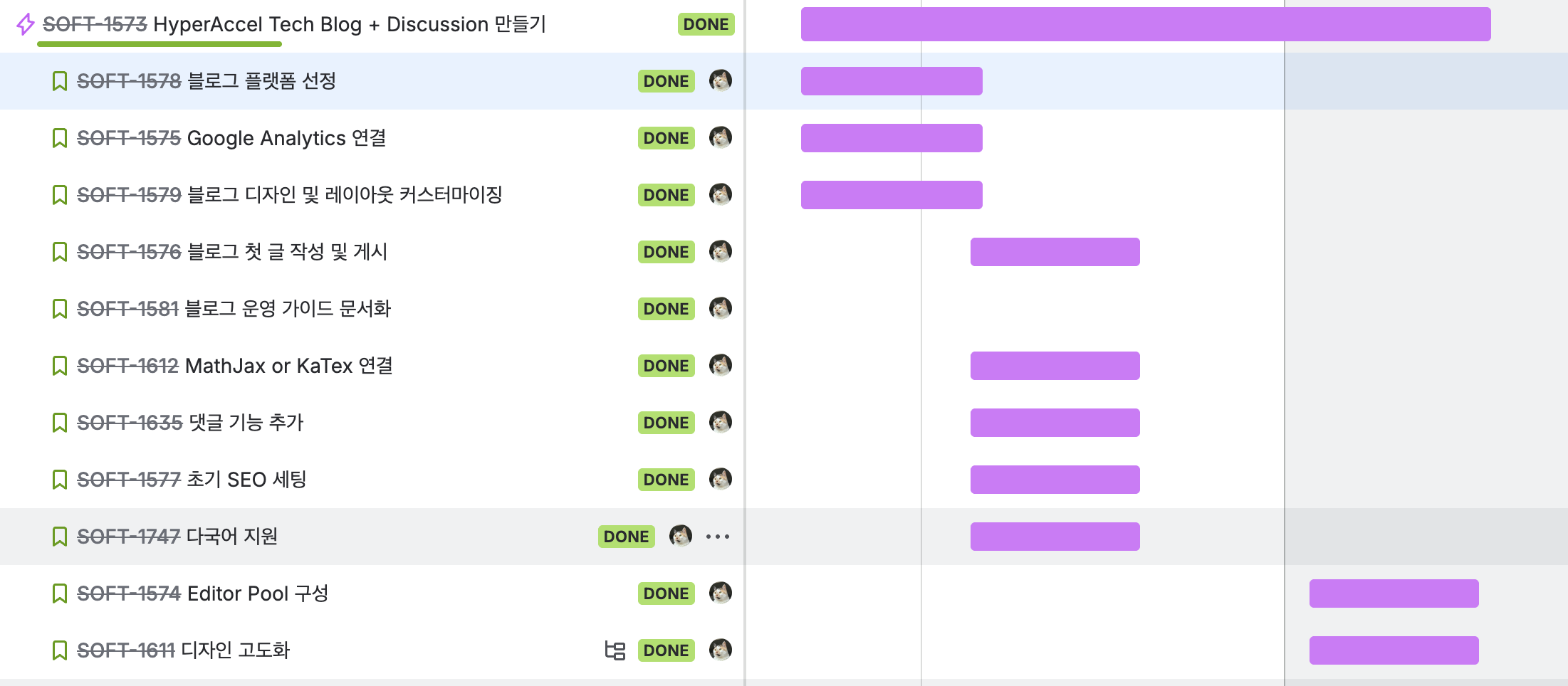
The Motivation Behind Starting Our Tech Blog
In our company’s SW group, we have a developer named Jaewoo Kim (Author, LinkedIn). Jaewoo is developing legato, a language for our HW kernel development. For several months, Jaewoo has been consistently requesting something from us.

Shouldn’t we have a company tech blog? (from Jaewoo)
Jaewoo mentioned that he had experience posting projects from his previous company on a tech blog, and thanks to those posts, many talented developers became interested in the company and even joined.
I also had been thinking a lot about wanting to share with external developers the many challenges we face in building high-performance LLM Inference Chips and creating Software Stacks to support those Chips.
But… who will build and operate it?
I knew that we had plenty of content to post on the blog in our company’s Wiki (operated on Confluence). However, having a lot of content to post and actually building and operating a blog are completely different challenges.
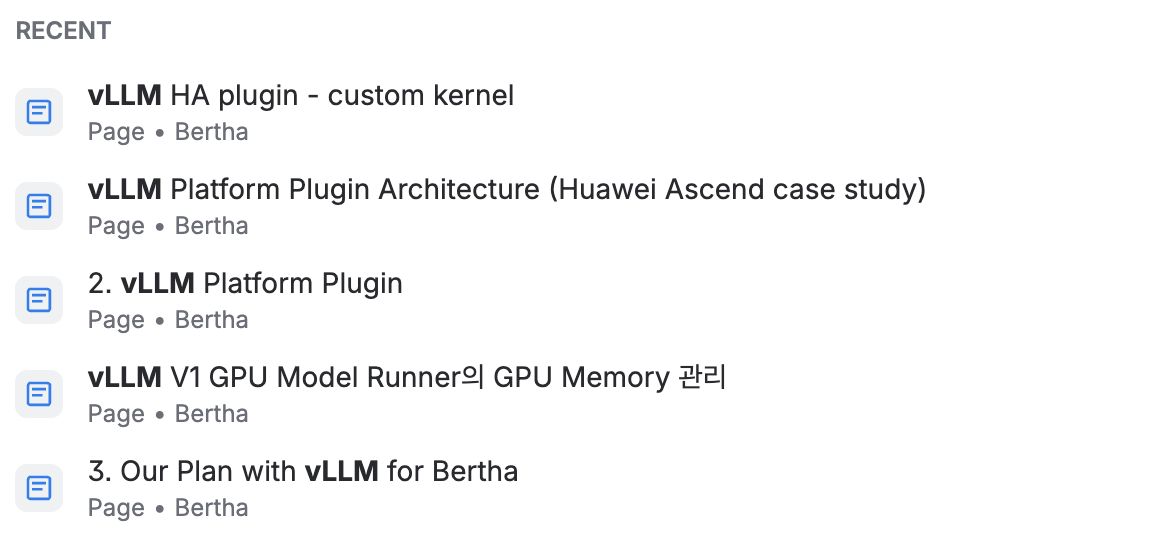
Open source analysis for HyperAccel’s LLM Inference Engine support (Coming Soon…)
Months had passed since Jaewoo suggested operating a tech blog, but no one had taken the initiative. That’s because no one had experience operating one!

But I actually had experience… I had been posting on my personal blog for several years.

However, I was pretending not to know, with a vague expectation that “someone else will step up, right?” and the thought that “I’m already too busy…”
But in October of this year, I had the opportunity to attend PyTorch Conference with Jaewoo (see previous post).
Seeing Jaewoo continuously discussing and developing the compiler with team members in Korean time even during his business trip to the US, I thought, “Is being busy just an excuse for me?”
And there was something I always tell my team members as a team lead.
“If you think you can do it, just do it” - that’s the mindset.
So I decided. I’ll do it
Choosing a Tech Blog Platform
When building a tech blog, there are several options.
- Using blog platforms
- Velog
- Medium
- Tistory
- …
- Self-hosting (using Static Site Generator + GitHub Pages)
- Jekyll
- Hugo
- …
Of course, the simplest approach would be using a blog platform. You can just sign up and create a blog.
However, I had several important factors in mind for operating a tech blog.
- Must have comment functionality
- Must be able to integrate Google Analytics
- Must have good SEO
- Must be easy to maintain
- Multiple users should be able to easily submit their posts
While other factors could be sufficiently supported by using blog platforms, ease of maintenance and allowing multiple users to easily submit their posts seemed difficult to achieve with blog platforms.
Wait, but shouldn’t using a blog platform make maintenance easier?
Yes. For personal blogs, using a blog platform would be much more convenient. However, there was a critical point we had to consider.
“Our tech blog should be operated by an Editor Group, not by a single employee.”
I really like the book Software Engineering at Google, and I apply many things I learned from it in team management. This book introduces the term Bus Factor.
Bus Factor: An index that represents how many team members working on a project can suddenly leave without proper handover procedures before the project is halted or faces a similarly serious situation.
The higher the Bus Factor, the more stable the project becomes, but if we operate the blog using a blog platform, if the blog operator (probably me?) falls into a situation where they cannot operate the blog, our tech blog will become a ghost blog.
However, if we self-host using GitHub, while I would need to do most of the blog setup, the operation can be handled by the Editor Group.
And so it began. Building a tech blog with Hugo
Building the Tech Blog!
My previous blog was built with Jekyll. However, Jekyll was difficult to modify themes, and being Ruby-based, it sometimes caused dependency issues. Since I had never used Ruby, when dependency problems occurred, I would just turn a blind eye and ignore them.

But when I looked into modern SSGs (Static Site Generators), I found Hugo, built with Go, which had diverse themes and an active community, so I started building the blog based on it.

And we also recruited people who wanted to participate in the Editor Group.

As many as 9 applicants!
And we completed implementing comment functionality, multilingual support (Korean, English), search functionality, Google Search registration, Google Analytics registration, Author functionality… everything!
Operating the Tech Blog
If you want to write a post on our tech blog, you can do so through a GitHub Pull Request. Since it operates through GitHub PRs, it’s a system where anyone who wants to write can freely submit posts, not just a specific administrator.
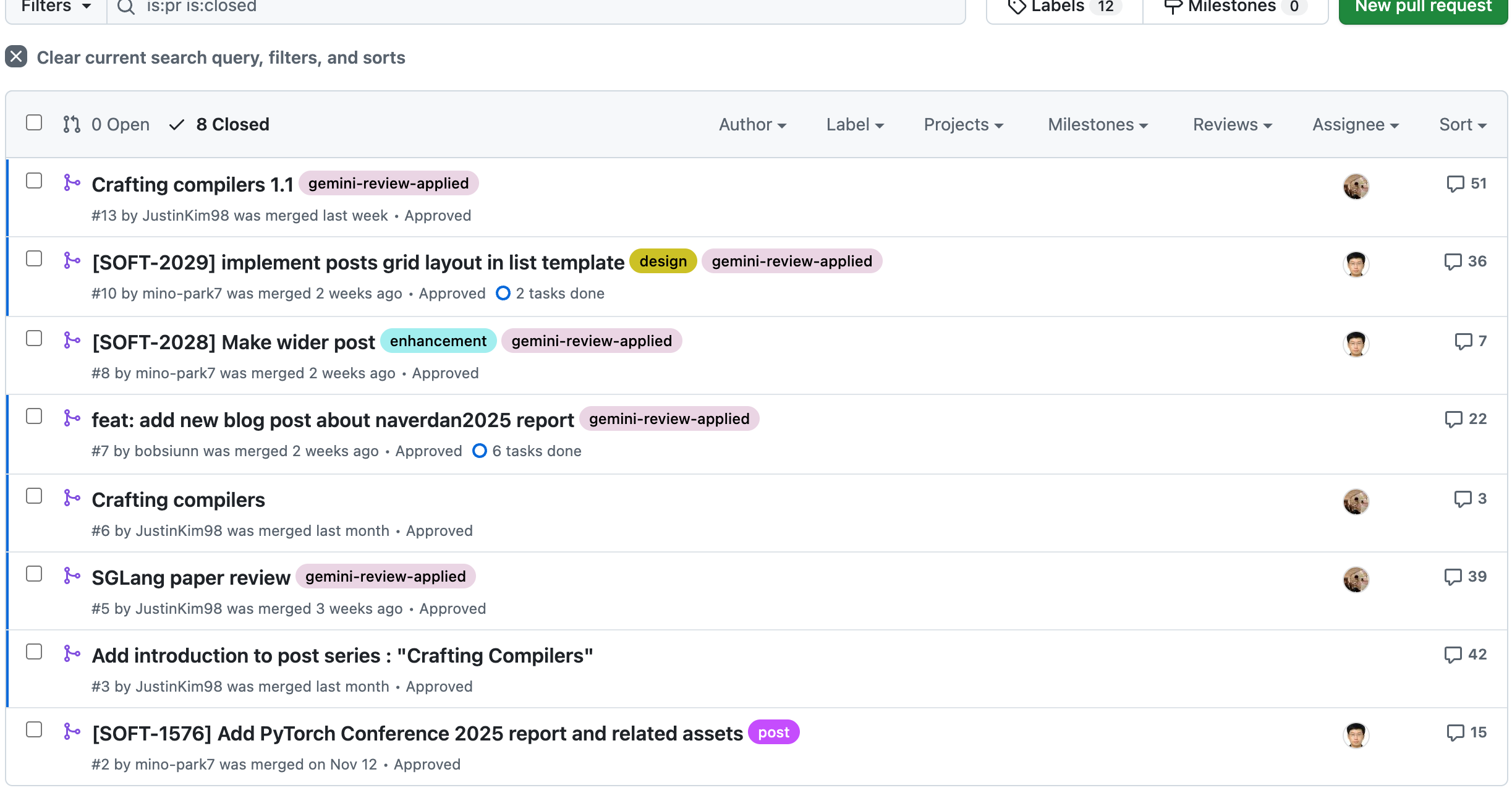
And, the Editor Group can freely leave comments with their opinions on posts in PRs.

The Editor Group has one very important role. That is to encourage developers to write tech blog posts.
I once posted a blog post called BERT 논문정리 after reading the BERT paper around 2018. Thankfully, so many people read this post that it appeared at the top of Google search results for a while.
Sharing what you’ve studied and researched externally is good for promoting the company’s technical capabilities, but I believe it should also serve as personal promotion, so I encourage developers to actively blog post content from our internal wiki that can be shared externally.
Upcoming Posts…
At HyperAccel, we develop everything from HW design for LLM Inference to the entire Software Stack for it.
That’s why we deal with a really wide range of technologies within one company. So the posts we’ll put on the tech blog will cover really diverse topics.
- How to build a Compiler?
- GPU characteristics (Know your enemy and know yourself)
- Open source analysis of LLM Inference Frameworks (vLLM, SGLang, …)
- Development of Kubernetes Components for Hardware support in Cluster environments
- Building an internal development environment based on Kubernetes
- …
We’re planning to share really diverse and high-quality posts, so please stay tuned!
HyperAccel is Hiring!
The biggest purpose of operating this tech blog is talent recruitment!
If you’re interested in the technologies we work with, please apply at HyperAccel Career!
HyperAccel has many excellent and brilliant engineers. We’re waiting for your applications.